Wednesday, March 18, 2026 | World Desk
What Happened Today
The Iran-Israel war took one of its most alarming turns yet on Wednesday as Israel confirmed the killing of two of Iran’s most powerful figures, and Iran responded by firing cluster-warhead missiles toward Israeli civilian areas, killing two people near Tel Aviv.
The situation, which has been escalating since fighting began on February 28, now extends well beyond a two-country military clash. Gulf energy infrastructure is under threat, global oil prices have surged to their highest levels in years, and outside powers including Russia are stepping into the diplomatic arena — raising fears that this conflict is becoming nearly impossible to contain.
Israel Kills Ali Larijani — One of Iran’s Most Influential Leaders
At the heart of Wednesday’s escalation is the death of Ali Larijani, 67, one of Iran’s most senior and respected political figures. Iranian authorities confirmed that Larijani was killed in an Israeli airstrike, dealing a significant blow to the country’s leadership at an already fragile moment.
Larijani had long been one of the key figures shaping Iran’s direction at the highest levels of government. He had recently been involved in sensitive diplomatic work, including discussions tied to nuclear negotiations. His death is not just a military event — it is a direct strike at the brain of Iran’s decision-making structure.
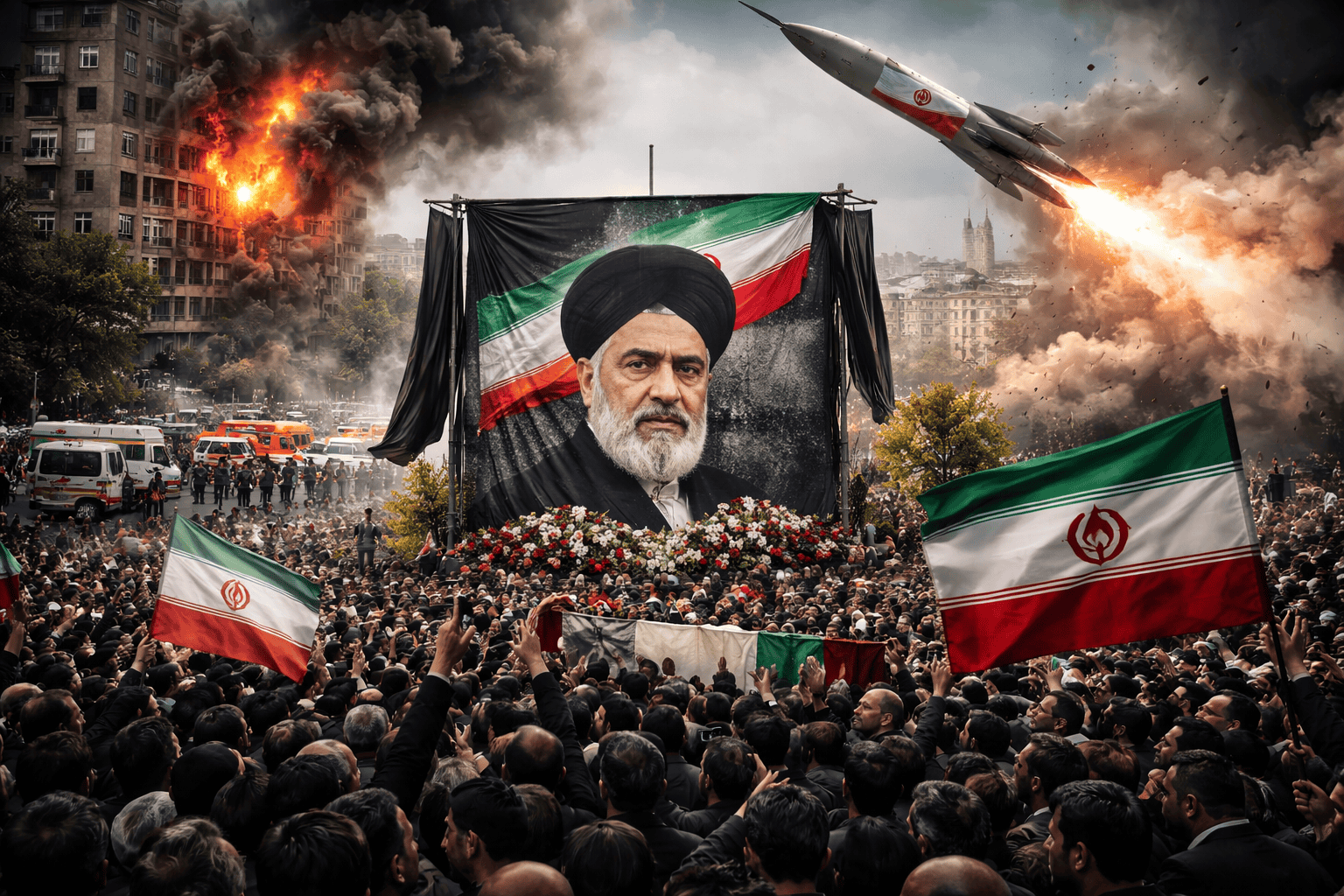
Iranian leadership reacted with fury, vowing swift and severe retaliation. Tehran’s streets filled with mourners as state officials framed the killing as a brazen political assassination.
Intelligence Chief Esmail Khatib Also Confirmed Dead
Adding to the shock, Israel announced it had also killed Iran’s intelligence minister, Esmail Khatib, in a separate overnight airstrike. The deaths of both Larijani and Khatib within 48 hours mark an extraordinarily aggressive Israeli strategy — one focused not merely on military targets, but on systematically dismantling Iran’s security and intelligence leadership.
Iranian officials described the back-to-back killings as the assassination of three senior security figures in two days. The psychological and strategic impact inside Tehran cannot be overstated.
Iran Fires Cluster Missiles — Two Killed Near Tel Aviv
Iran’s retaliation came quickly. Missile fire resumed toward Israel, and one missile carrying cluster submunitions broke apart in the air over civilian areas near Tel Aviv, killing two people and damaging infrastructure including a major train station.
Cluster warheads are among the most feared weapons in modern conflict because they are extremely difficult to intercept once they split apart mid-air, scattering dozens of smaller bomblets over a wide area. The danger does not end with the initial strike — unexploded bomblets can remain active on streets and in public spaces for days or weeks, posing an ongoing threat to civilians.
According to Israeli officials, roughly half of all missiles fired by Iran since the war began on February 28 have been cluster warheads. That detail alone explains why each new Iranian barrage generates deep alarm well beyond the immediate death toll.
Gulf Energy Infrastructure Threatened — Oil Prices Spike Above $108
Perhaps the most globally consequential development on Wednesday came from Iran’s Revolutionary Guard, which issued direct threats against energy facilities in Saudi Arabia, Qatar, and the United Arab Emirates. Iran has also been targeting Gulf energy infrastructure more broadly, and the Strait of Hormuz — through which roughly one-fifth of the world’s oil supply normally passes — has become nearly impassable.
The result has been a sharp and sustained rise in global oil prices. Brent crude climbed above $108 a barrel, a level reflecting serious market anxiety about supply disruptions. Since the war began, benchmark oil prices have risen by close to 50%. Gulf producers and the United States are reportedly working to find alternative supply routes and workarounds to prevent a full-blown energy crisis.
The ripple effects of a prolonged Hormuz shutdown would be felt in transport costs, manufacturing, and household fuel bills across much of the world — not just in the Middle East.
Russia Condemns the Killings, Calls for Ceasefire
Russia weighed in on Wednesday, with the Kremlin formally condemning what it described as the “murder” of Iranian leaders in what it called U.S.-Israeli airstrikes. Moscow renewed its calls for an immediate ceasefire and a return to negotiations.
Russia’s close ties to Tehran make its position no surprise, but the public statement underscores how rapidly this conflict is drawing in outside powers — politically if not yet militarily. What began as a bilateral confrontation is increasingly being watched, and commented on, by major global players with their own stakes in the outcome.
The Bigger Picture: A War That Is Widening Fast
Every aspect of this conflict is expanding. The targets are getting more senior. The weapons are getting more dangerous. The geography is spreading beyond Iran and Israel into the Gulf. The economic consequences are reaching global markets. And the diplomatic space for a resolution appears to be shrinking with every new airstrike and every fresh barrage of missiles.
For ordinary people — in Tehran mourning their leaders, in Israeli neighborhoods picking through debris, and in Gulf cities watching energy prices climb — the war is not an abstraction. It is an immediate and worsening reality.
Independent verification of all claims made by the warring sides remains difficult in real time. But the direction of this conflict is clear: it is deepening, and the window to stop it from spreading further is closing.