New Delhi, March 17, 2026 | Political Desk
The Short Version
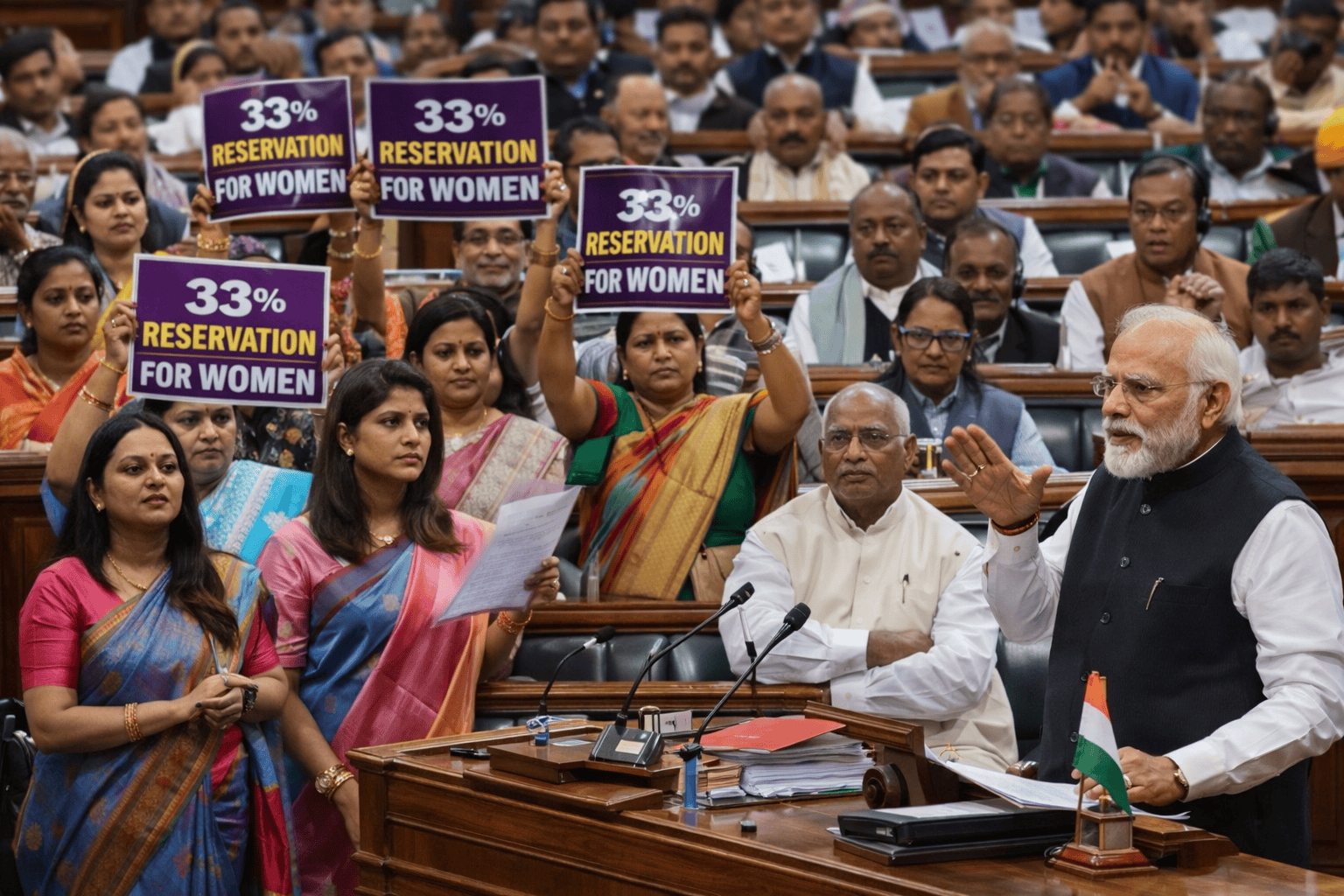
The Modi government is preparing to introduce an amendment to the Nari Shakti Vandan Adhiniyam — the Women’s Reservation Act — in Parliament as early as Monday. The goal is to strip out the condition that has kept the law frozen on paper for over two years: the requirement that women’s reservation can only take effect after a census and a fresh delimitation of constituencies. If the amendment succeeds, 33% reservation for women in the Lok Sabha and state assemblies could become a reality in the 2029 general elections — and possibly even in upcoming state assembly polls.
There is just one major problem. The BJP does not have the numbers to pass a constitutional amendment on its own, and it knows it.
Why the Original Law Is Stuck
To understand why this amendment is being proposed now, it helps to go back to September 2023, when the Modi government passed the Nari Shakti Vandan Adhiniyam during a special session of Parliament held in the new Parliament building. The Constitution (One Hundred and Twenty-Eighth Amendment) Bill, 2023 was approved by the Rajya Sabha with 214 members voting in favour and none against — a day after the Lok Sabha passed it with 454 votes for and only two against. News on Air
It was a historic moment — the culmination of a legislative battle that had been going on since 1996. But the celebration came with a catch buried in the fine print.
In the present form of the Nari Shakti Vandan Adhiniyam, the Act provides for 33% reservation for women in the Lok Sabha and state assemblies, but its implementation is linked to the completion of the next census and subsequent delimitation, making 2031 the likely timeline. The Tribune
That is not a minor delay. It means a law that was passed with near-unanimous fanfare in 2023 may not actually change a single election until 2031 — eight years after it was enacted.
What the Government Now Wants to Change
Sources indicate there is a proposal to advance the implementation by two years to 2029. “For this to happen, the Act would need to be amended. This is possible only by revisiting the provisions related to the completion of the census and the delimitation exercise,” a source said. The Tribune
In practical terms, this means removing or modifying the clause in the law that ties women’s reservation to the post-census delimitation process. If that condition is removed, the government could push for reservation to apply from the next round of assembly elections — a move that carries obvious political weight with West Bengal elections approaching — and then in the 2029 Lok Sabha polls.
But making that change is not a simple matter of drafting new legislation. It requires amending the Constitution itself.
The Numbers Problem: BJP Doesn’t Have the Votes
This is where the government’s plan runs into a hard wall. Amending the Constitution under Article 368(2) requires a bill to be passed by a majority of the total membership of each house and by not less than two-thirds of the members present and voting. The BJP and its NDA allies do not currently hold that two-thirds threshold in both the Lok Sabha and the Rajya Sabha.
That means the government needs the opposition — and specifically, it needs the Congress to come on board.
Union Parliamentary Affairs Minister Kiren Rijiju has reportedly been reaching out to opposition leaders in recent days to build support for the amendment. But the response from Congress has been more procedural than enthusiastic.
Kharge’s Letter: Support the Bill — But Do It Properly
Congress President Mallikarjun Kharge responded to Rijiju’s outreach by noting that the Nari Shakti Vandan Adhiniyam was passed unanimously by Parliament in September 2023, and that “thirty months later, the government is, in your own words, ‘seeking an opportunity to interact with me and the senior members of my party to deliberate upon the modalities and roadmap for the implementation of this landmark constitutional amendment.'” Outlook India
The tone of Kharge’s letter was pointed. He did not say no — but he did question why the government is suddenly in a hurry on a law it passed 30 months ago and has not moved on since.
Kharge has written to Rijiju urging him to convene an all-party meeting chaired by Prime Minister Narendra Modi, saying the proposed discussion should involve all opposition parties rather than limited consultations with individual leaders. The Tribune
Sources within the government say that in response, the possibility of holding such an all-party meeting under PM Modi’s leadership is being seriously considered. That meeting, if it happens, could be the first step toward building the cross-party coalition needed to push the amendment through Parliament.
The Political Calculation: Women Voters and West Bengal
None of this is happening in a political vacuum. With West Bengal state elections approaching, a fresh push on women’s reservation carries a clear electoral message — particularly to women voters in a state where political competition between the BJP and the Trinamool Congress is intense.
Activating the women’s reservation issue now, and framing the BJP as the party that is fighting to make it real, is a political narrative the ruling party is unlikely to be shy about. Analysts have noted that even if the amendment faces hurdles, being seen as the party pushing for early implementation strengthens the BJP’s hand with women voters in several key states.
At the same time, opposing the amendment would put the opposition in an uncomfortable position — it is politically difficult to argue against reserving seats for women, even if the procedural objections are legitimate.
Nearly Three Decades in the Making
It is worth remembering just how long India has been trying to do this. The initial bill addressing women’s reservation was first presented as the 81st Constitutional Amendment Bill in 1996 during the Janata Dal-led United Front government under HD Deve Gowda. It was introduced multiple times during the tenure of Atal Bihari Vajpayee, yet failed to amass the necessary numerical support. Wikipedia
The Congress-led UPA government passed the bill in the Rajya Sabha in 2010, but it was never taken up in the Lok Sabha and lapsed. It took until 2023 — 27 years after it was first tabled — for both houses of Parliament to finally pass a women’s reservation law. And now, just two and a half years after that, the Modi government is acknowledging that the law as written may not actually deliver reservation in any election before 2031.
The proposed amendment is, in effect, an admission that the 2023 law needed a better implementation mechanism — and a race against time to fix it before the 2029 elections make the issue moot.
What Happens Next
The amendment is expected to be introduced in Parliament on Monday. Whether it moves quickly or gets bogged down in negotiations depends almost entirely on whether the government can bring together enough opposition parties to meet the two-thirds constitutional threshold.
For now, Congress has not said no — but it has said: not without everyone at the table. If PM Modi chairs that all-party meeting, the political signal it sends would itself be significant: that on this particular issue, the government is willing to treat the amendment as a national effort rather than a ruling party achievement.
Whether that goodwill extends to the voting booth in Parliament will be the real test.
This is a developing political story. Updates will follow as Parliament proceedings unfold.