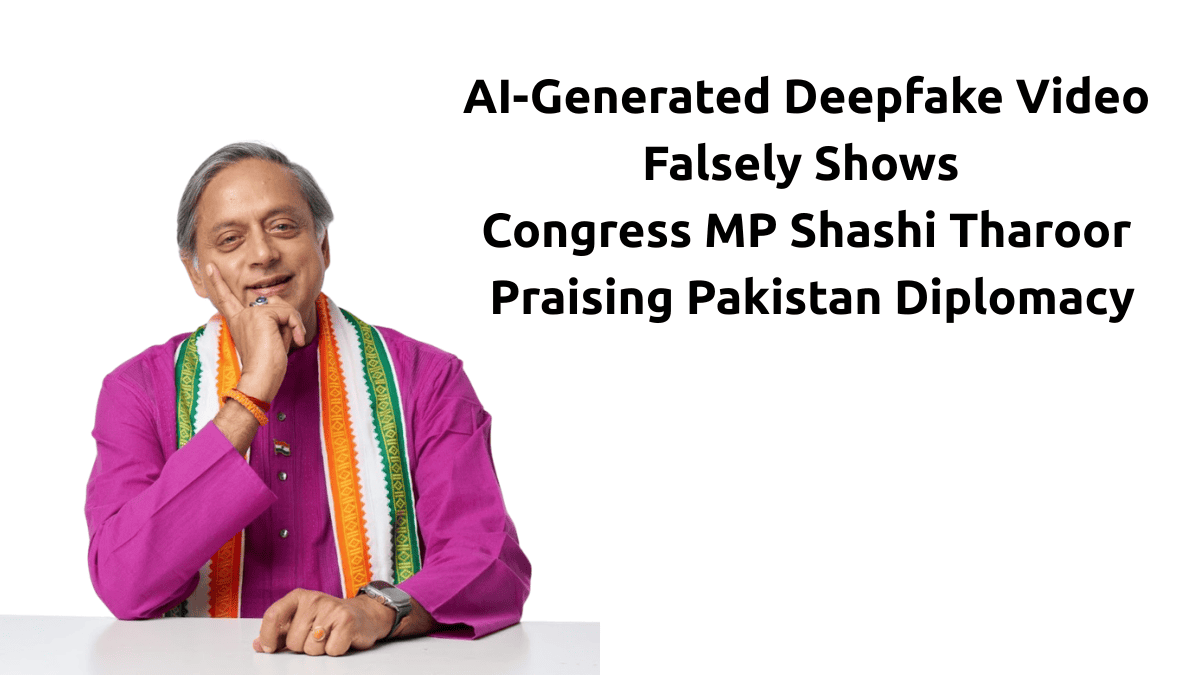
In a stark reminder of the growing threat posed by artificial intelligence-powered misinformation, a fabricated video depicting Congress Member of Parliament Shashi Tharoor has been circulating widely across social media platforms, prompting urgent warnings from fact-checkers and the politician himself.
The Viral Deepfake
The manipulated footage, which gained significant traction on pro-Pakistan social media accounts, purportedly shows Tharoor appearing on India Today’s platform with journalist Rajdeep Sardesai. In the doctored clip, the Thiruvananthapuram MP appears to deliver scathing criticism of Prime Minister Narendra Modi’s government while lauding Pakistan’s diplomatic initiatives.
According to the fake audio overlay, Tharoor allegedly states that Pakistan’s mediation in US-Iran tensions represents a “massive strategic failure by the Indian government” and claims Pakistan is “rebranding itself as a global net stability provider.” The fabricated statements also reference the Bollywood film “Dhurandhar 2,” suggesting India remains distracted by entertainment while losing diplomatic ground.
Comprehensive Fact-Checking Exposes Fraud
Leading fact-checking organizations across India, including Alt News, India Today, Factly, BOOM, and The Quint, conducted independent investigations that conclusively exposed the video as fraudulent. Their findings reveal a sophisticated manipulation operation:
Original Source Identified: The genuine footage dates back to December 26, 2025, when Tharoor participated in an India Today discussion about India’s foreign policy challenges. The original conversation centered on Bangladesh relations, US tariff impacts, and post-Operation Sindoor dynamics with Pakistan—topics entirely different from those in the viral clip.
Technical Analysis: Digital forensics experts identified multiple red flags in the manipulated video. Visual anomalies include inconsistent lip-sync patterns, jaw distortions at the six-second mark, and audio characteristics inconsistent with Tharoor’s natural speaking voice and cadence. AI detection tools flagged the content as likely manipulated, with audio identified as artificially generated.
Timeline Discrepancy: The original interview predates current US-Iran-Pakistan diplomatic developments by several months, making the purported statements chronologically impossible.
Tharoor’s Direct Response
On April 9, 2026, Tharoor issued a public statement addressing what he described as an “alarming number of deepfake videos” featuring fabricated content attributed to him. The Congress leader expressed disappointment that social media users were accepting these manipulations without verification.
“There are convincing-sounding AI-generated voice-overs over genuine footage of old interviews, having ‘me’ saying things I have never said,” Tharoor wrote on X (formerly Twitter). He provided a verification guideline for his followers: “If a statement doesn’t appear on my timeline nor on that of the purported interviewer/media source, it’s fake news.”
The Growing Deepfake Problem
This incident represents just one example in an escalating pattern of deepfake attacks targeting Tharoor. Previous fabricated videos have falsely depicted him making statements about cricket diplomacy, the ICC T20 World Cup, and various political controversies. Each incident follows a similar pattern—genuine interview footage manipulated with AI-generated audio to create entirely false narratives.
The sophistication of these deepfakes has increased dramatically. Earlier attempts featured obvious audio mismatches and poor lip-sync quality. Recent versions demonstrate advanced AI capabilities that can closely mimic speech patterns, though expert analysis still reveals telltale inconsistencies.
Verification Methods Employed
Fact-checkers utilized multiple verification techniques to expose the fraud:
- Reverse Image Search: Keyframe analysis led investigators to the original December 2025 interview on India Today’s YouTube channel.
- Side-by-Side Comparison: Visual analysis revealed identical backgrounds, clothing, and camera angles between the viral clip and original footage, but with completely different audio content.
- AI Detection Tools: Platforms like Hive Moderation flagged the audio as AI-generated with high confidence levels.
- Contextual Analysis: Experts noted that Tharoor’s alleged statements used phrasing and vocabulary patterns inconsistent with his established communication style.
Broader Implications
The incident highlights critical vulnerabilities in India’s digital information ecosystem as the nation approaches crucial political events. The timing of this particular deepfake—emerging amid actual Pakistan-mediated diplomacy between the US and Iran—demonstrates how manipulators exploit current events to lend false credibility to fabricated content.
Pakistani journalists and verified accounts amplified the deepfake, with some garnering over 166,000 views before fact-checkers exposed the fraud. This cross-border amplification pattern suggests coordinated disinformation efforts designed to influence political discourse in both countries.
Expert Perspectives
Digital security analysts warn that deepfake technology has reached a critical inflection point where average social media users struggle to distinguish authentic content from sophisticated manipulations. The technology required to create convincing deepfakes has become increasingly accessible, lowering barriers for malicious actors.
“We’re witnessing the democratization of advanced manipulation tools,” noted cybersecurity researchers tracking the phenomenon. “What once required specialized knowledge and resources can now be accomplished with consumer-grade software.”
Protecting Against Deepfake Misinformation
Experts recommend several protective measures for social media users:
Source Verification: Always check official verified accounts of public figures and news organizations before accepting controversial statements as authentic.
Technical Scrutiny: Look for visual inconsistencies in videos, including unnatural eye movements, lip-sync mismatches, and audio quality variations.
Context Assessment: Consider whether alleged statements align with the speaker’s established positions and communication patterns.
Fact-Check Consultation: Utilize established fact-checking organizations before sharing sensational content.
Platform Reporting: Report suspected deepfakes to social media platforms and relevant authorities.
Government Response Framework
India’s updated IT rules, designed to combat deepfake proliferation, mandate removal of identified manipulated content within three hours of verification. However, implementation challenges persist as platforms struggle to balance rapid response requirements with thorough verification processes.
The incident underscores ongoing debates about platform responsibility, user education, and technological solutions for combating AI-generated misinformation in democratic societies where information integrity directly impacts political discourse and electoral processes.
Conclusion
The Shashi Tharoor deepfake case serves as a cautionary tale about the evolving landscape of digital misinformation. As AI technology continues advancing, the gap between authentic and fabricated content narrows, placing unprecedented responsibility on media consumers to exercise critical judgment and verification diligence.
Tharoor’s proactive response and the swift fact-checking community mobilization demonstrate the importance of multi-stakeholder cooperation in defending information integrity. However, the ease with which these manipulations spread—and the difficulty in containing them once viral—reveals significant vulnerabilities requiring urgent technological, regulatory, and educational interventions.
FACT-CHECK VERIFICATION SUMMARY:
Claim: Video shows Shashi Tharoor criticizing Modi government and praising Pakistan’s diplomatic efforts
Verdict: FALSE – The video is an AI-generated deepfake
Evidence:
- Original footage from December 26, 2025, discusses different topics (Bangladesh, tariffs)
- Multiple fact-checking organizations confirmed manipulation
- AI detection tools identified synthetic audio
- Tharoor personally confirmed he never made these statements
- Visual analysis revealed lip-sync inconsistencies and technical anomalies
Sources Consulted:
- Alt News (Primary fact-check)
- India Today (Original interview source)
- Factly
- BOOM
- The Quint
- Shashi Tharoor’s verified X account
- Multiple Indian news agencies
Confidence Level: CONFIRMED DEEPFAKE (100% certainty based on multiple independent verifications)